Copy • Creative • Strategy | Bill Abramovitz
When Möller introduced an innovative balancing system, head-swapping technology, and neuro navigation for its neurosurgical microscope, the challenge was to quickly communicate the benefits of the new system. Altogether, the innovations reduced the time of the procedures and improved patient outcomes.
Möller-Wedel
Neurosurgical microscopes
Neurosurgeons, OR nurses, and hospital buyers
Introduce microscope balancing system,neuro navigation, and microscope head-swapping technology to surgeons
Translating complex technical concepts into quick reading print executions.
Trade advertising • Trade show graphics • Sales support materials
Neurosurgical microscopes are judged by their optics, precision, stability, ergonomics, and performance in the operating room. Möller’s new balancing and head-wapping technologies enabled surgeons and OR nurses to quickly position and rebalance the microscope during delicate procedures. The original strategy emphasized neuro-navigation.
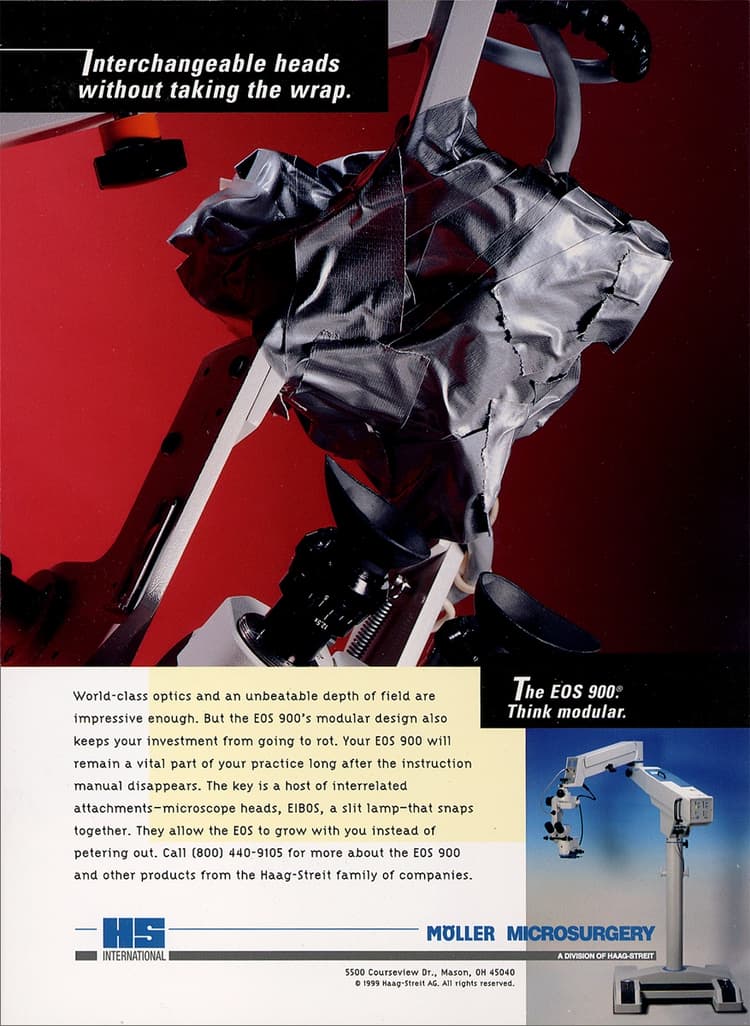
However, after one-on-one interviews with OR nurses and surgeons, the ease of swapping the microscope's head and the automatic rebalancing were identified as the primary benefits. In the past, these procedures could take up to 20 minutes or more, and often required jerry-rigging to stabilize the microscope head.
The strategic challenge was to translate a technical product feature into a benefit surgeons could immediately understand: less time adjusting equipment and closing the surgical field.
The core insight was that the most persuasive message was not about the neuro-navigation system, but the advantage of reducing the time patients needed to spend on the table with the surgical field exposed
By connecting faster rebalancing to surgical efficiency, the campaign elevated the product story from “new feature” to “clinical benefit.” That shift made the communication more relevant, more memorable, and easier for the sales team to explain.
The campaign used concise messaging and innovative images to make a complex product's advantages immediately understandable. Instead of leading with specifications, the creative work focused on the surgeon’s experience: control, efficiency, and confidence during demanding microsurgical procedures.
Trade advertising, exhibit graphics, and sales support materials carried a consistent strategic message. Each piece helped move the conversation away from technical novelty and toward a more compelling question: how does this innovation improve the way surgeons work?
By positioning the innovation around surgical efficiency, the work helped differentiate the microscope in a competitive medical device market and gave the sales team a clear value proposition.
The campaign sold out the stock of microscopes in two months.
Successful medical device marketing begins with aligning the product's benefits to the ideal target audience.